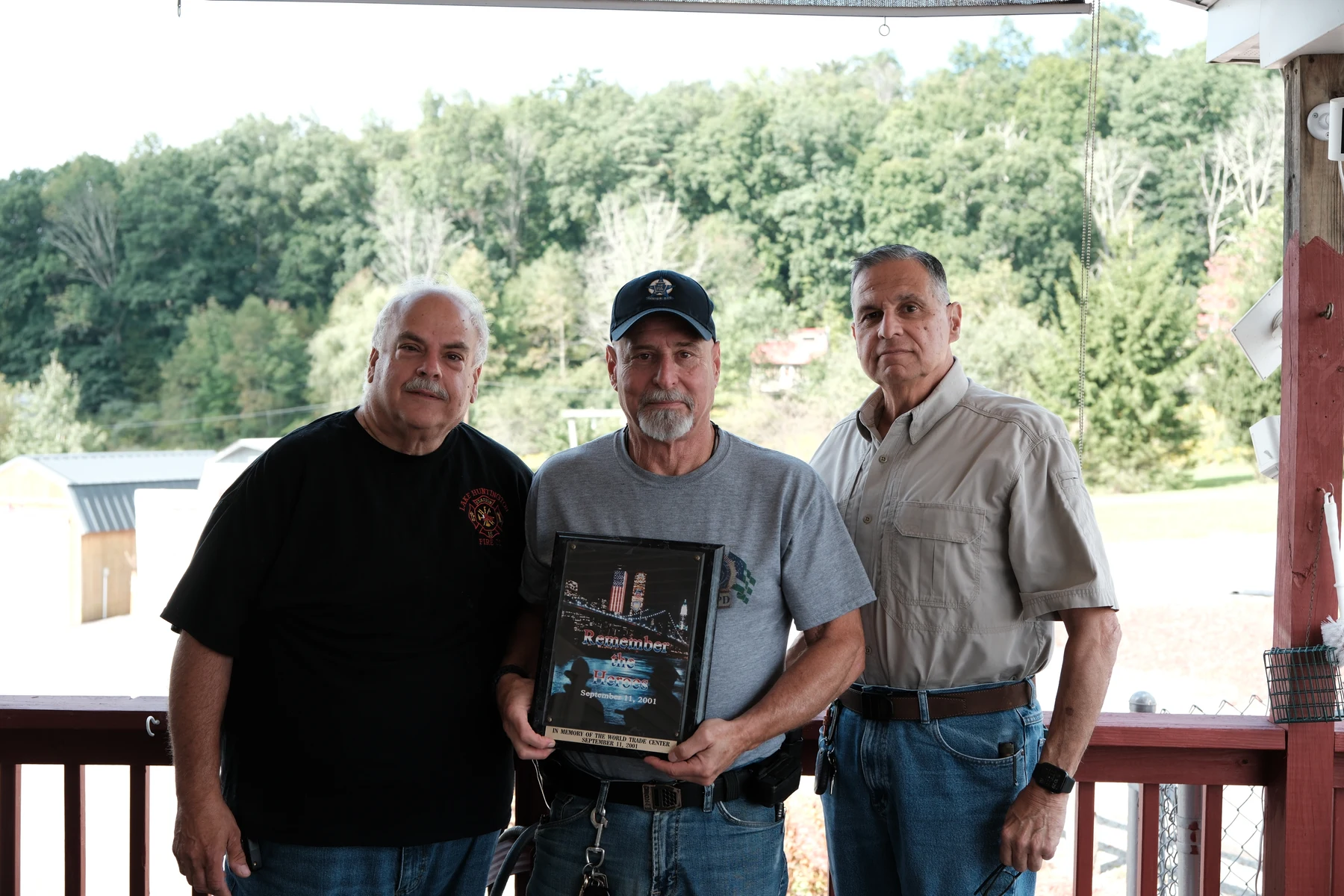
DAMASCUS, PA — Twenty-five years after they responded to the Sept. 11 terrorist attacks, retired New York City Police Department detectives Joe Costa, John Tucci and Barry Anfang still carry reminders of that day in their lungs.
All three Damascus residents have pulmonary nodules that doctors continue to monitor. Tucci and Anfang have developed cancer. Costa, who has multiple nodules and scarring in one lung, endures recurring bouts of bronchitis that have worsened over time.
Their experiences on Sept. 11 carried them to different parts of the response. Tucci narrowly escaped the collapse of the South Tower and searched for survivors. Anfang helped identify vehicles and recover evidence from World Trade Center debris at the former Fresh Kills Landfill. Costa searched for victims near City Hall, worked inside a temporary morgue and later collected DNA from their families.
Together, their stories trace the attack from the first frantic hours through a recovery effort that lasted months, and into a health crisis that continues a quarter-century later.
Tucci, 74, was assigned to the NYPD’s Technical Assistance Response Unit, known as TARU. He was having breakfast when news of the first attack appeared on television. He reached Lower Manhattan about 10 minutes after the second plane struck.
Tucci and other officers began establishing a temporary headquarters near West and Liberty streets. As he walked toward the South Tower, he saw a body fall between himself and a firefighter. A supervisor called him back moments later.
Then he heard a growing roar.
“It sounded like a jet engine,” Tucci recalled. “It wasn’t a jet engine, but it was getting louder. We looked up, and the South Tower was falling.”
Tucci and approximately 20 others ran toward the World Financial Center but became trapped near an entrance. Tucci was at the bottom of the pile. A lieutenant fired his handgun into a plate-glass window, shattering it and creating a way into the building.
Inside, ceiling tiles hung overhead and electrical sparks flashed around them. The group moved toward the Hudson River, but Tucci realized one of his partners was missing.
He joined a firefighter who was also searching for someone and returned toward the ruins.
“It was surreal,” Tucci said. “There was nothing there.”
He found his partner walking in a daze and pulled him toward the river. They placed him aboard an NYPD launch that carried him to a hospital in New Jersey.
TARU later used electronic and amplification equipment to search for cellular signals from people who might have been trapped beneath the rubble. Tucci said the unit continued searching even after officials believed there was little hope of finding survivors.
He also catalogued vehicles, cleared paths and helped move debris. In the early weeks, he helped obtain approximately 40 rental vehicles for police and outside agencies arriving to assist. Tucci said Enterprise supplied the vehicles without charging the department.
What stayed with him was not only the devastation, but what was missing.
The towers had contained offices, banks, desks, chairs and telephones. Yet Tucci said nearly everything had been pulverized. During days of searching, one of the few recognizable objects he saw was the numbered keypad from an office telephone.
“That was the only recognizable thing,” he said. “You didn’t see any furniture.”
Anfang, 70, was driving to his assignment with Staten Island Auto Crime when he heard on the radio that an aircraft had struck the first tower. He initially assumed it was a small plane and an accident and was astounded that such an accident could happen on such a sunny day.
His office on Bay Street faced Lower Manhattan. When he arrived, his sergeant was photographing the scene with surveillance equipment. The Chief of Detectives’ office called and ordered the officers into uniform.
Then the second plane struck.
Anfang helped clear routes to the Staten Island Ferry and Verrazzano-Narrows Bridge so emergency vehicles could reach Manhattan. Near the ferry, he assisted people arriving from the city covered in dust and debris.
With officers unsure whether further attacks were coming, Anfang went home and retrieved two rifles. He feared attackers might attempt to come ashore elsewhere in the city.
“We didn’t know anything except they attacked us,” he said. “It could come from any direction at any time.”
Anfang was later assigned to the former Fresh Kills Landfill on Staten Island, which was temporarily reopened to receive material from the World Trade Center site. Investigators spent approximately 1.7 million hours examining about 1.5 million tons of debris for human remains, personal possessions and evidence.
Anfang helped identify more than 900 vehicles crushed at or near the World Trade Center. Investigators compared the vehicles with the names of people who remained missing, hoping to provide answers to their families.
Some vehicles contained human remains. Officers also recovered firearms, handcuffs, police placards and personal effects. Evidence was turned over to the Joint Terrorism Task Force.
Anfang remembered several nuns who walked through the recovery site each day and blessed those working there. Although he is Jewish, he called their presence one of the most profound religious experiences of his life.
“We were on sacred ground at that dump,” he said, referring to the many lost souls whose vehicles and remains were recovered there.
At Ground Zero, whenever workers found remains, the machinery stopped. Police officers, sanitation workers and construction crews formed two lines as the remains were carried from the site to an ambulance.
Anfang said recovering remains at least allowed some families to bury their loved ones. Others received only fragments. Some received nothing.
He recalled the rivalry that traditionally existed between New York City police officers and firefighters. That rivalry fell away as he considered the firefighters and NYPD Emergency Service officers who entered the towers.
“They knew they were going to die,” Anfang said.
Tucci and Costa agreed.
Costa, 64, was assigned to the Brooklyn North Warrant Squad. He had spent the morning practicing at a shooting range in the Bronx with his partner and sergeant.
Afterward, they drove to his partner’s home in Hicksville, where his partner’s mother ran outside and told them a plane had struck the World Trade Center. They went inside and watched the second plane hit.
The officers drove to Brooklyn, collected their equipment and continued toward City Hall. One of the towers collapsed as they arrived.
“You couldn’t see your hand two feet in front of you,” Costa said.
People emerged through the dust covered from head to toe, appearing to him “like ghosts.” He initially helped those fleeing the area before being assigned to search for survivors and recover remains.
Officers converted a damaged clothing store beside a firehouse into a temporary morgue. Bodies and partial remains were brought inside, where Costa and others searched for identification that might help authorities notify families.
He worked for close to 12 hours before sleeping on the floor of the neighboring firehouse. He later searched the pile for driver’s licenses, identification cards and other evidence.
Several weeks after the attack, Costa worked at a bereavement center where relatives of the missing provided DNA samples and brought personal belongings that could assist in identifying remains.
One child approached Costa and his partner holding a photograph.
“Could you find my father?” the girl asked.
"She lost it," Costa said, "She ran out crying."
"[For weeks] we had to deal with so many poor little kids coming and showing us pictures of their family, their mother, their father, their brother," Costa said, "That was one of the hardest things we did."
The dangers did not end when the rubble was cleared.
Costa moved from Long Island to Damascus in 2011. About a year later, he began developing bronchitis repeatedly despite having suffered from it only a handful of times before Sept. 11.
Doctors found pulmonary nodules and scarring in one lung. A CAT scan in May revealed additional nodules that will require continued observation. He sees his pulmonologist every three months, undergoes breathing tests every six months and receives an annual CAT scan.
When another bout of bronchitis begins, he takes antibiotics and prednisone and sometimes relies on a nebulizer. The episodes now last longer and hit harder than they once did. Every two weeks, he receives an injection intended to help him breathe.
“It’s a constant battle,” Costa said. “You get your good days and your bad days.”
He was also diagnosed with post-traumatic stress disorder last year. The World Trade Center Health Program covers all treatments related to 9/11 related injuries, which Costa said would otherwise cost thousands of dollars each month.
His respiratory condition prevents him from performing strenuous work, but he remains active with the Lake Huntington Fire Department as captain of its fire police. Including his previous service on Long Island, Costa has spent about 45 years as a volunteer firefighter.
Tucci has had basal-cell skin cancer and has a stable lung nodule. He recently underwent testing after a possible sign of blood cancer, but said his follow-up numbers were good.
Anfang has also had skin cancer and another cancer that required the invasive surgery. A lung nodule found during other medical testing has not grown.
The three men praised the World Trade Center Health Program for monitoring their conditions, arranging examinations and covering treatment for certified illnesses. They also credited the staff at CVS in Honesdale with helping local responders navigate their prescriptions.
Anfang brought attention to an Aug. 31 New York Post analysis of World Trade Center Health Program data. The newspaper reported that cancer certifications increased from 3,204 in 2015 to 57,044 in 2026, a rise of 1,680 percent. The increase reflects both illnesses emerging after long latency periods and growth and aging among the program’s enrolled population.
Despite their illnesses and the losses they witnessed, Anfang said responders would answer the call again.
“We took an oath to the city and the country,” he said. “Most guys take that seriously.”
The three men now belong to a wider community of former New York City police officers, firefighters and other Sept. 11 responders who settled in and around northeastern Pennsylvania and Sullivan County. They check on one another, gather for memorials and assist when someone needs help.
They worry that the attacks are receding from living memory. Costa noted that many adults today were either children on Sept. 11 or had not yet been born.
The three planned to join approximately 25 other former responders for a Sept. 11 memorial ceremony at the Wayne County Courthouse. They said remembrance does not begin and end with an annual ceremony.
They remember the friends they lost throughout the year.
“All gave some,” Anfang said, repeating the words responders adopted after the attacks, “and some gave all.”